
Bootstrapping vs Funding Which Path Should Your Startup Choose
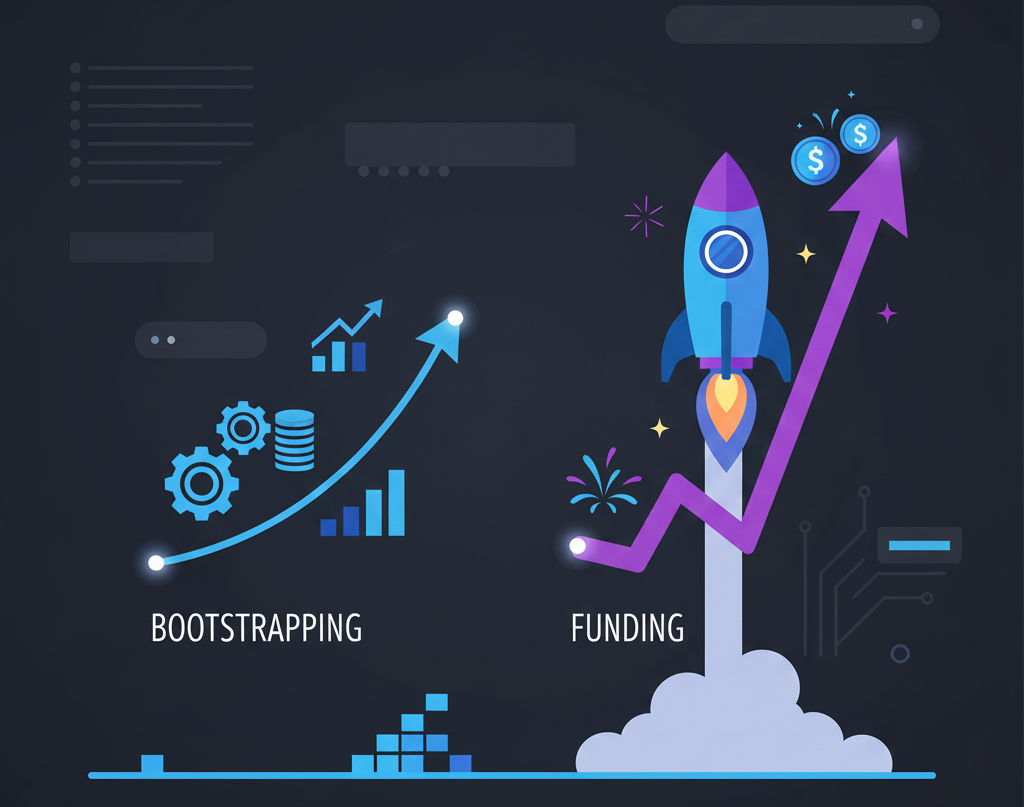
Choosing how to finance your startup is one of the most important decisions a founder will ever make. The path you choose—bootstrapping or seeking external funding—will shape your company’s pace of growth, control, risk, and long-term strategy.
There is no “one best option” for everyone. The right choice depends on your product, market, goals, and mindset as a founder.
What Is Bootstrapping?
Bootstrapping means building your startup using personal savings, early revenue, and minimal external help.
This path forces founders to stay lean, efficient, and creative with limited resources.
Why Bootstrapping Works
- You stay in full control of your business.
- You learn discipline and smart money management.
- You build a profitable business from the start.
What Is Fundraising?
Funding means taking money from angels, venture capitalists (VCs), accelerators, or institutional investors.
This path is for startups that need capital to grow fast or capture the market before competitors do.
Why Funding Works
- You get the money needed for fast expansion.
- You can invest in hiring, marketing, and product development.
- You grow faster than competitors.
When You Should Choose Bootstrapping
Bootstrapping is ideal when:
1. Your business can generate early revenue
Examples: services, SaaS with small MVP, consulting, agencies.
2. You want full control of decisions
No investor pressure, no board approvals.
3. You prefer slow, steady, sustainable growth
You grow based on money you actually make.
4. Your expenses are low and manageable
You don’t need millions to build your product.
5. You’re building a lifestyle or long-term independent business
Bootstrapping suits founders who prefer ownership over speed.

When You Should Choose Funding
Funding is ideal when:
1. You’re entering a fast-moving or competitive market
Examples: AI, e-commerce, EV, fintech.
2. Your product requires expensive development
Apps, hardware, biotech, large-scale platforms.
3. You want rapid scaling
You aim to dominate the market quickly.
4. You need expert mentorship and connections
Investors open doors you can’t open alone.
5. You're building a unicorn-level company
If your goal is big valuation and global expansion, funding helps.
Pros and Cons at a Glance
Bootstrapping Pros
✔ Full control
✔ Revenue-focused
✔ Lower pressure
✔ Ownership stays with founders
Bootstrapping Cons
✘ Slower growth
✘ Limited resources
✘ Harder to compete in large markets
Funding Pros
✔ Faster scaling
✔ More resources
✔ Access to investor expertise and networks
✔ Ability to hire better talent
Funding Cons
✘ Dilution of ownership
✘ Pressure to grow fast
✘ Investor influence on decisions
So, Which Path Should You Choose?
Choose Bootstrapping if:
-
Your business can grow with low capital
-
You want control and independence
-
You prefer profit-driven growth
-
You are okay with slower but stable scaling
Choose Funding if:
-
Your idea needs big investment to build
-
You want rapid market dominance
-
You're comfortable giving equity
-
You are aiming for large-scale success fast
Factor Bootstrapping Funding (VC/Angel) Control Founder keeps 100% control Equity shared with investors Speed of Growth Slow but steady Fast, aggressive scaling Risk Lower financial risk Higher expectations, pressure Money Source Personal savings + revenue Investor capital Decision-Making Fully independent Influenced by investors Business Discipline High discipline, focus on profits Burn rate may increase When Ideal Small, lean startups High-growth, scalable startups
Final Conclusion
Both paths are valid—just for different kinds of startups.
Bootstrapping builds ownership-driven, profitable companies, while funding builds fast-scaling, high-growth companies.
Choose the path that aligns with your vision, resources, product, and long-term ambition.